
Towards the end of May, Chris was back in his local Goodwill. While he hasn’t had much luck at this particular store in a long time, this day he came across a Sunbeam Coffeemaster. We have seen these many times in the past and have always passed on it. One of the reasons we never picked one up is that we could never get the top chamber off the bottom. This time it was different. Chris was able to remove it and it was really clean inside.

Chris at Goodwill taking the picture of the Sunbeam Coffeemaster that he texted to me. Photo by the authors.
Of course neither of knew if it worked or not. Taking a chance. Chris did test it a couple of days later and was happy to report that worked fine. I always thought the Sunbeam Coffeemaster was a post-World War II product, and was very much surprised to learn that it was introduced in the fall of 1938. I’ve should have known better, since it carries the same “T9” design as the famous Sunbeam “T9” toaster also introduced in the late 1930s.

The circa 1939 Sunbeam Toastermaster breakfast set. Image from 1stdibs.com.
To borrow a line from John Crowley’s poignant 1984 documentary about the 1939 New York World’s Fair, The World of Tomorrow –
I think there are moments where you can see the world turning from what it is into what it will be –
and the Sunbeam Coffeemaster is one of those moments. When Sunbeam introduced the Coffeemaster in the late ’30s, it was a cumulation of just over 100 years of vacuum or siphon coffee making. The earliest patent for a vacuum coffee maker dates to the 1830s filed by Leoff of Berlin. But the real credit for popularizing vacuum coffee needs to go to Marie Fanny Amelne Massot (patented under the name of Madame Vassieux) of Lyon, France and her patent and design of the first commercially successful vacuum coffee maker of 1841. Vassieux’s coffee maker introduced the classic vacuum pot look, two glass chambers resembling an hour glass.

Madame Vassieux’s “glass balloon” coffee pot of 1841. Illustration from baharris.org.
By the early Twentieth-Century the vacuum coffee pot had come to the United States. With Corning Glass’ development of Pyrex ovenproof glass in 1915, the manufacture of a shatterproof vacuum coffee maker became possible. The Silex Coffee pot hit the stores the same year.

Advertisement for the 1915 Silex Percolator from Weaver’s Hardware Store, Rochester, New York. Democrat & Chronicle, April 10, 1915, Pg 19.
By the 1930s the Silex coffee maker developed into the familiar hourglass style that could be used on a stove top or on an electric heater.

Silex Glass Coffee Maker advertisement. The Daily Astorian October 27, 1933, Pg. 6.
Silex also had a number of vacuum pot competitors, including Sunbeam.

1930s Sunbeam Coffee Maker. Ad from the Omaha World-Herald, February 23, 1935, Pg. 4.
These vacuum coffee pots were certainly not automatic, one had to stir the grounds and the water and the pot needed to be removed from the heat source for the coffee to drop into the lower chamber. That changed with the introduction of Faberware’s Coffee Robot towards the end of 1937. Finally, a coffee maker that could do it all (almost) automatically. It will stir the coffee and keep it hot all day. The only thing you need to do is to open the valve in the back to prevent the coffee from going back up into the glass balloon on the top.

Faberware Coffee Robot. Buffalo Courier Express, May 26, 1938, Pg. 10.
And in 1938 the Chicago Flexible Shaft Company (Sunbeam) hired a 20th Century Renaissance man, Alfonso Iannelli to design a new coffee pot. Born in Italy on February 17, 1888, Iannelli immigrated to the United States at the age of 10. Under Gustav Borglum he studied sculpture, but it was while he painting posters for vaudeville acts at Los Angeles Orpheum Theatre that he met architect John Lloyd Wright. Wright, impressed by Iannelli’s work introduced him to his famous father, Frank Lloyd Wright. In 1914, the elder Wright invited Iannelli to work on his enormous entertainment venue Midway Gardens.

Frank Lloyd Wright’s Midway Gardens, circa 1914. Photo from the Frank Lloyd Wright Foundation.

Alfonso Iannelli and his wife, circa 1916. Image from arcchicago.blogspot.com.
Iannelli created the “sprite” sculptures for Midway Gardens.

A group of Iannelli “Sprites” adorning a wall at Midway Gardens. Photo from Pinterest.
Not surprisingly Wright did not credit Iannelli for his work and even claimed he created the sculptures. This led to a break between them and Iannelli never worked with Wright again. Around 1919, Iannelli and his wife Margaret set up a studio in Park Ridge, Illinois. The many facets of their work, from sculpture to stain glass to graphic design and industrial design, were created in this studio.
In 1929-1930 Iannelli created twelve, bronze zodiac plaques for Chicago’s Adler Planetarium.

The Adler Planetarium in Chicago, circa 1930. Image from The Man On Five.

The 12 bronze zodiac plaques around the facade of the Adler Planetarium. Image from reddit.com.
Just after the Adler’s completion, Iannelli received design commissions for a number of exhibits at the 1933-1934 Century of Progress exposition in Chicago, including the facade of the Social Science Hall.

Iannelli’s Facade of the Social Science Hall, 1933. From the booklet, Sculpture A Century of Progress, Pg. 23

Alfonso Iannelli, circa 1935, around time of the Wahl-Eversharp commision. Image from timeout.com.
The fountain pen company Wahl-Eversharp hired Iannelli to design a top-of-the-line gold pen and mechanical pencil in the mid-1930s. The set eventually named Coronet was introduced during the 1936 holiday season.

The Wahl-Eversharp Coronet pen and pencil set. Image from the chicagodesignarchive.org.
Soon after the introduction of the Coronet set, Iannelli set to work designing the new toaster and coffee pot for Sunbeam. What Sunbeam wanted was a completely automatic, electric, vacuum coffee pot as their new flagship model, eventually named the Coffeemaster C20. Sunbeam was already using the “Coffeemaster” name on an earlier non-vacuum, non-automatic set from the mid-1930s. There will be more about this set in a future post.

Sunbeam Coffeemaster set, 1934 – 1938. From the collection of the authors.
Iannelli’s design, while still the basic shape of vacuum pots, looked like something from the future. Rising from a Bakelite base, that rests on four tear-dropped feet with a chrome band, are the two vessels of chrome-plate over copper. The “T-9” is etched into the bottom, serving vessel. Topping it all off is a vented lid with a Bakelite finial.

Advertising artwork for the Sunbeam C20 that clearly shows the engraved “T9” on the serving vessel. Image from the chicagodesignarchive.org.
It has been said that the Iannelli’s inspiration for the “T9” came from the theme center of the 1939 New York World’s Fair, the Perisphere and Trylon.

The Trylon and Perisphere in mid-afternoon. Image from mcny.org
Whether or not that is true we leave for you to decide. But it added a nice modern touch to the appliances and gave cohesion to the new line.
-

- 1938 patent drawing for the C20 Coffeemaker. Image from Google Patents.

-
- Patent drawing for the upper bowl for the C20 Coffeemaster. Image from Google Patents.

-
- The patent drawing for the lower section of the C20 Coffeemaster. Image from Google Patents.

Sunbeam’s new Coffeemaster hit the stores in the autumn of 1938. This was a truly an automatic coffee pot. Fill the bottom with the desired amount of water, then add the appropriate amount of coffee into the top section, set the switch to high and walk away. After the exact amount of brewing time in the upper vessel, the pot sets the switch to low and the coffee empties into the bottom section. Take the top section off and place the lid on the bottom for a stylish serving coffee pot that while plugged in keeps the coffee at the proper temperature.

The New Sunbeam Coffeemaster. Advertisement from the Battle Creek Moon-Journal, September 25, 1938, Pg. 2.
Another major selling point of the new Coffeemaster was its durability. Being plastic and chrome-plated it wouldn’t be breakable like its all glass competitors. And even though its price was hefty at $15.00 (the equivalent of $343.15 in 2025), it was in the same price range as other vacuum coffee pots. For an extra $7.50 one could purchase the entire set that included the cream and sugar and tray.

The Sunbeam Coffeemaster C20A set with sugar, cream and tray. Photo from ebay.
The new Coffeemaster proved to be an immediate hit. And judging by how many can be found today, sold really well.
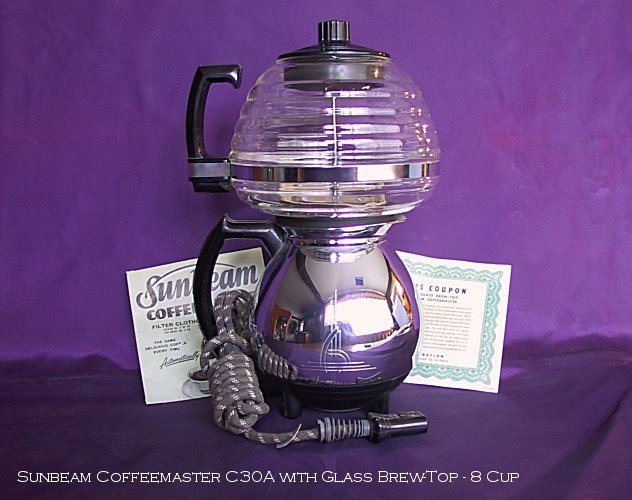
With metal shortages during the Second World War, Sunbeam did their bit by using glass for the upper vessel. Today collectors refer to this glass top as the “beehive”.

Sunbeam C30A with the wartime glass “beehive” top. Photo from baharris.org.
The “beehive” pots sold for $5.00 less than the all metal pot. It is quite rare to find a Sunbeam C30 with this variant, because it came with a redemption coupon for the customer to replace the glass top with the metal version once the wartime restrictions were lifted.

World War II coupon that came with the glass “beehive” top. Image from baharris.org.
After the end of the war and with the restrictions lifted, production returned to an all metal coffeemaker. In 1948 the revised C30 Coffeemaster was introduced. Beside having an improved filter the best revision came from the glass top. While the original Coffeemaster lacked a handle on the top vessel, the temporary glass tops did. And now the postwar version also came with an upper handle. This made the removal of the top section much easier. The plastic base was slightly revised, too. The separate ball feet became legs incorporated into the base with the heating element which simplified production.

An early advertisement for the double-handle Sunbeam Coffeemaster. Ad from the Nebraska City News Press, October 18, 1948, Pg. 2.
It was this double-handle, Sunbeam Coffeemaster C30A that Chris picked up. It is a handsome looking coffeemaker and it makes great coffee.

The Sunbeam C30A Coffeemaster that Chris picked up at the Goodwill. Photo from the collection of the authors.
But the big problem of these pots today is its rubber gasket. When stored in less than ideal conditions, and just with age, the seals harden and makes it difficult to impossible to disengage the two sections. And I will admit, even with a pliable gasket, it takes a bit of strength to separate the two chambers. However, once the pot heats up, the gasket does soften a bit.
-

- The separated two sections of the Coffeemaster showing the rubber gasket. Photo from the collection of the authors.

-

- A look at the filter inside the top section of the Coffeemaster. Photo from the collection of the authors.



Detail of the T9 engraved on the bottom section of the Coffeemaster. Photo from the collection of the authors.

The Coffeemaster’s bottom serving vessel. Photo from the author’s collection.
In 1954 Sunbeam introduced their automatic percolator and the era of the vacuum coffeemaker was drawing to a close.

The Sunbeam Automatic Percolator. Ad from the Ventura Star, March 18, 1954, Pg. 26.
In 1960 Sunbeam would remodel the Coffeemaster one more time. The C50 Coffeemaster had an increased 10 cup capacity, no longer featured the engraved “T9”, a turning knob replaced the sliding switch on the base and instead of a handle on the upper section, there were two levers that one pushed up to release the top.

Sunbeam advertisement from the Chicago Tribune, September 11, 1960, Pg. 216.

The C50 Coffeemaster, Sunbeam’s last vacuum coffeemaker. Image from Etsy.
Sunbeam ceased production of the C50 Coffeemaster in mid-1967, bringing to a close their vacuum coffeemaker era. Today vacuum, now called siphon, coffeepots are making a resurgence as coffee devotees are realizing how good the coffee they make tastes.

Present day vacuum pot by Bodum. Image from bodum.com.
While the new “siphon” pots have the classic look, we think the C30A that was found at the Goodwill is far more stylish.

Circa 1950 Sunbeam C30A Coffeemaster. Photo from the collection of the authors.
Anthony & Chris (The Freakin’, Tiquen Guys
Sources
Websites
- archchicago.blogspot.com
- baharris.org
- chicagodesignarchive.org
- edgarmiller.org
- franklloydwright.com
- oldcoffeeroasters.com
- richardspens.com