Category Archives: Art Deco

Sunbeam Coffeemaster: Chris’ Recent Thrift Store Find

Towards the end of May, Chris was back in his local Goodwill. While he hasn’t had much luck at this particular store in a long time, this day he came across a Sunbeam Coffeemaster. We have seen these many times in the past and have always passed on it. One of the reasons we never picked one up is that we could never get the top chamber off the bottom. This time it was different. Chris was able to remove it and it was really clean inside.

The Sunbeam Coffeemaster at Goodwill that Chris sent to me.

Chris at Goodwill taking the picture of the Sunbeam Coffeemaster that he texted to me. Photo by the authors.

Of course neither of knew if it worked or not. Taking a chance. Chris did test it a couple of days later and was happy to report that worked fine. I always thought the Sunbeam Coffeemaster was a post-World War II product, and was very much surprised to learn that it was introduced in the fall of 1938. I’ve should have known better, since it carries the same “T9” design as the famous Sunbeam “T9” toaster also introduced in the late 1930s.

The famous Sunbeam Toastmaster.

The circa 1939 Sunbeam Toastermaster breakfast set. Image from 1stdibs.com.

To borrow a line from John Crowley’s poignant 1984 documentary about the 1939 New York World’s Fair, The World of Tomorrow

I think there are moments where you can see the world turning from what it is into what it will be –

and the Sunbeam Coffeemaster is one of those moments. When Sunbeam introduced the Coffeemaster in the late ’30s, it was a cumulation of just over 100 years of vacuum or siphon coffee making. The earliest patent for a vacuum coffee maker dates to the 1830s filed by Leoff of Berlin. But the real credit for popularizing vacuum coffee needs to go to Marie Fanny Amelne Massot (patented under the name of Madame Vassieux) of Lyon, France and her patent and design of the first commercially successful vacuum coffee maker of 1841. Vassieux’s coffee maker introduced the classic vacuum pot look, two glass chambers resembling an hour glass.

Illustration of Madame Vassieux's vacuum coffee pot of 1841.

Madame Vassieux’s “glass balloon” coffee pot of 1841. Illustration from baharris.org.

By the early Twentieth-Century the vacuum coffee pot had come to the United States. With Corning Glass’ development of Pyrex ovenproof glass in 1915, the manufacture of a shatterproof vacuum coffee maker became possible. The Silex Coffee pot hit the stores the same year.

1915 advertisement for the Silex Percolator.

Advertisement for the 1915 Silex Percolator from Weaver’s Hardware Store, Rochester, New York. Democrat & Chronicle, April 10, 1915, Pg 19.

By the 1930s the Silex coffee maker developed into the familiar hourglass style that could be used on a stove top or on an electric heater.

1933 ad for the Silex Glass Coffee Maker.

Silex Glass Coffee Maker advertisement. The Daily Astorian October 27, 1933, Pg. 6.

Silex also had a number of vacuum pot competitors, including Sunbeam.

1930s advertisement for the Sunbeam vacuum coffee maker.

1930s Sunbeam Coffee Maker. Ad from the Omaha World-Herald, February 23, 1935, Pg. 4.

These vacuum coffee pots were certainly not automatic, one had to stir the grounds and the water and the pot needed to be removed from the heat source for the coffee to drop into the lower chamber. That changed with the introduction of Faberware’s Coffee Robot towards the end of 1937. Finally, a coffee maker that could do it all (almost) automatically. It will stir the coffee and keep it hot all day. The only thing you need to do is to open the valve in the back to prevent the coffee from going back up into the glass balloon on the top.

1938 ad for Faberware's Coffee Robot.

Faberware Coffee Robot. Buffalo Courier Express, May 26, 1938, Pg. 10.

And in 1938 the Chicago Flexible Shaft Company (Sunbeam) hired a 20th Century Renaissance man, Alfonso Iannelli to design a new coffee pot. Born in Italy on February 17, 1888, Iannelli immigrated to the United States at the age of 10. Under Gustav Borglum he studied sculpture, but it was while he painting posters for vaudeville acts at Los Angeles Orpheum Theatre that he met architect John Lloyd Wright. Wright, impressed by Iannelli’s work introduced him to his famous father, Frank Lloyd Wright. In 1914, the elder Wright invited Iannelli to work on his enormous entertainment venue Midway Gardens.

Midway Gardens in Chicago, designed by Frank Lloyd Wright.

Frank Lloyd Wright’s Midway Gardens, circa 1914. Photo from the Frank Lloyd Wright Foundation.

Alfonso Iannelli and his wife in his studio, circa 1916.

Alfonso Iannelli and his wife, circa 1916. Image from arcchicago.blogspot.com.

Iannelli created the “sprite” sculptures for Midway Gardens.

Sprites on a wall at Midway Gardens.

A group of Iannelli “Sprites” adorning a wall at Midway Gardens. Photo from Pinterest.

Not surprisingly Wright did not credit Iannelli for his work and even claimed he created the sculptures. This led to a break between them and Iannelli never worked with Wright again. Around 1919, Iannelli and his wife Margaret set up a studio in Park Ridge, Illinois. The many facets of their work, from sculpture to stain glass to graphic design and industrial design, were created in this studio.

In 1929-1930 Iannelli created twelve, bronze zodiac plaques for Chicago’s Adler Planetarium.

1930 view of the Adler Planetarium in Chicago.

The Adler Planetarium in Chicago, circa 1930. Image from The Man On Five.

Iannelli's 12 bronze plaques on the facade of the Adler Planetarium.

The 12 bronze zodiac plaques around the facade of the Adler Planetarium. Image from reddit.com.

Just after the Adler’s completion, Iannelli received design commissions for a number of exhibits at the 1933-1934 Century of Progress exposition in Chicago, including the facade of the Social Science Hall.

The facade of the Social Science Hall, Century of Progress, Chicago, 1933.

Iannelli’s Facade of the Social Science Hall, 1933. From the booklet, Sculpture A Century of Progress, Pg. 23

Alfonso Iannelli, circa 1935.

Alfonso Iannelli, circa 1935, around time of the Wahl-Eversharp commision. Image from timeout.com.

The fountain pen company Wahl-Eversharp hired Iannelli to design a top-of-the-line gold pen and mechanical pencil in the mid-1930s. The set eventually named Coronet was introduced during the 1936 holiday season.

The Coronet pen and pencil set by Wahl-Eversharp, designed by Alfonso Iannelli.

The Wahl-Eversharp Coronet pen and pencil set. Image from the chicagodesignarchive.org.

Soon after the introduction of the Coronet set,  Iannelli set to work designing the new toaster and coffee pot for Sunbeam. What Sunbeam wanted was a completely automatic, electric, vacuum coffee pot as their new flagship model, eventually named the Coffeemaster C20. Sunbeam was already using the “Coffeemaster” name on an earlier  non-vacuum, non-automatic set from the mid-1930s. There will be more about this set in a future post.

The Sunbeam Coffeemaster set of 1934 - 1938.

Sunbeam Coffeemaster set, 1934 – 1938. From the collection of the authors.

Iannelli’s design, while still the basic shape of vacuum pots, looked like something from the future. Rising from a Bakelite base, that rests on four tear-dropped feet with a chrome band, are the two vessels of chrome-plate over copper. The “T-9” is etched into the bottom, serving vessel. Topping it all off is a vented lid with a Bakelite finial.

Advertising artwork for the Sunbeam C20.

Advertising artwork for the Sunbeam C20 that clearly shows the engraved “T9” on the serving vessel. Image from the chicagodesignarchive.org.

It has been said that the Iannelli’s inspiration for the “T9” came from the theme center of the 1939 New York World’s Fair, the Perisphere and Trylon.

The Trylon and Perisphere from the Court of Communications.

The Trylon and Perisphere in mid-afternoon. Image from mcny.org

Whether or not that is true we leave for you to decide. But it added a nice modern touch to the appliances and gave cohesion to the new line.

Sunbeam’s new Coffeemaster hit the stores in the autumn of 1938. This was a truly an automatic coffee pot. Fill the bottom with the desired amount of water, then add the appropriate amount of coffee into the top section, set the switch to high and walk away. After the exact amount of brewing time in the upper vessel, the pot sets the switch to low and the coffee empties into the bottom section. Take the top section off and place the lid on the bottom for a stylish serving coffee pot that while plugged in keeps the coffee at the proper temperature.

Ad for Sunbeam's New Coffeemaster, 1938.

The New Sunbeam Coffeemaster. Advertisement from the Battle Creek Moon-Journal, September 25, 1938, Pg. 2.

Another major selling point of the new Coffeemaster was its durability. Being plastic and chrome-plated it wouldn’t be breakable like its all glass competitors. And even though its price was hefty at $15.00 (the equivalent of $343.15 in 2025), it was in the same price range as other vacuum coffee pots. For an extra $7.50 one could purchase the entire set that included the cream and sugar and tray.

The Sunbeam Coffeemaster C20A set.

The Sunbeam Coffeemaster C20A set with sugar, cream and tray. Photo from ebay.

The new Coffeemaster proved to be an immediate hit. And judging by how many can be found today, sold really well.

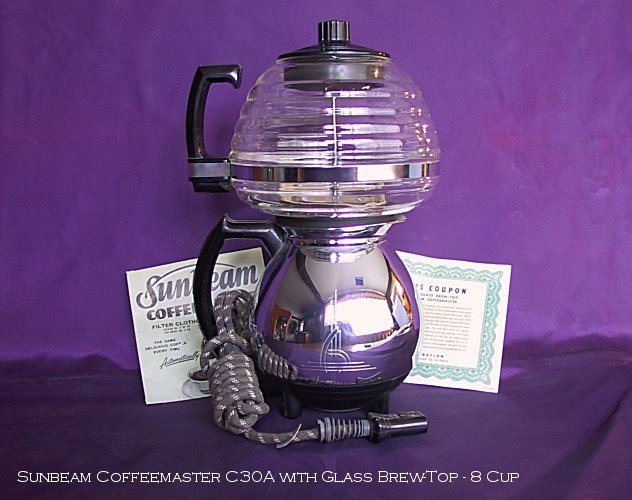
With metal shortages during the Second World War, Sunbeam did their bit by using glass for the upper vessel. Today collectors refer to this glass top as the “beehive”.

Sunbeam C30A with the "beehive" variant top.

Sunbeam C30A with the wartime glass “beehive” top. Photo from baharris.org.

The “beehive” pots sold for $5.00 less than the all metal pot. It is quite rare to find a Sunbeam C30 with this variant, because it came with a redemption coupon for the customer to replace the glass top with the metal version once the wartime restrictions were lifted.

World War II Sunbeam redemption coupon.

World War II coupon that came with the glass “beehive” top. Image from baharris.org.

After the end of the war and with the restrictions lifted, production returned to an all metal coffeemaker. In 1948 the revised C30 Coffeemaster was introduced. Beside having an improved filter the best revision came from the glass top. While the original Coffeemaster lacked a handle on the top vessel, the  temporary glass tops did. And now the postwar version also came with an upper handle. This made the removal of the top section much easier. The plastic base was slightly revised, too. The separate ball feet became legs incorporated into the base with the heating element which simplified production.

Ad for the double handle Sunbeam Coffeemaster, October 18, 1948, Nebraska City News Press.

An early advertisement for the double-handle Sunbeam Coffeemaster. Ad from the Nebraska City News Press, October 18, 1948, Pg. 2.

It was this double-handle, Sunbeam Coffeemaster C30A that Chris picked up. It is a handsome looking coffeemaker and it makes great coffee.

Color photo of the Sunbeam C30A Coffeemaster with double Bakelite handle.

The Sunbeam C30A Coffeemaster that Chris picked up at the Goodwill. Photo from the collection of the authors.

But the big problem of these pots today is its rubber gasket. When stored in less than ideal conditions, and just with age, the seals harden and makes it difficult to impossible to disengage the two sections. And I will admit, even with a pliable gasket, it takes a bit of strength to separate the two chambers. However, once the pot heats up, the gasket does soften a bit.

Detail of the T9 engraving on the bottom section of the Coffeemaster.

Detail of the T9 engraved on the bottom section of the Coffeemaster. Photo from the collection of the authors.

The Coffeemaster's bottom serving vessel.

The Coffeemaster’s bottom serving vessel. Photo from the author’s collection.

In 1954 Sunbeam introduced their automatic percolator and the era of the vacuum coffeemaker was drawing to a close.

The 1954 Sunbeam Automatic Percolator.

The Sunbeam Automatic Percolator. Ad from the Ventura Star, March 18, 1954, Pg. 26.

In 1960 Sunbeam would remodel the Coffeemaster one more time. The C50 Coffeemaster had an increased 10 cup capacity, no longer featured the engraved “T9”, a turning knob replaced the sliding switch on the base and instead of a handle on the upper section, there were two levers that one pushed up to release the top.

1960 Sunbeam Ad from the Chicago Tribune.

Sunbeam advertisement from the Chicago Tribune, September 11, 1960, Pg. 216.

Sunbeam's last vacuum coffee pot, the C50 Coffeemaster.

The C50 Coffeemaster, Sunbeam’s last vacuum coffeemaker. Image from Etsy.

Sunbeam ceased production of the C50 Coffeemaster in mid-1967, bringing to a close their vacuum coffeemaker era. Today vacuum, now called siphon, coffeepots are making a resurgence as coffee devotees are realizing how good the coffee they make tastes.

A present day vacuum coffeemaker by Bodum.

Present day vacuum pot by Bodum. Image from bodum.com.

While the new “siphon” pots have the classic look, we think the C30A that was found at the Goodwill is far more stylish.

Circa 1950 Sunbeam C30A Coffeemaster.

Circa 1950 Sunbeam C30A Coffeemaster. Photo from the collection of the authors.

Anthony & Chris (The Freakin’, Tiquen Guys

Sources

Websites

  • archchicago.blogspot.com
  • baharris.org
  • chicagodesignarchive.org
  • edgarmiller.org
  • franklloydwright.com
  • oldcoffeeroasters.com
  • richardspens.com

Madam Satan

Madan Satan - AFI Centennial Celebration

April 26, 2025

Recently, Anthony and I had the great honor of being asked by the Film Club of the Art Deco Society of Washington D.C. (ADSW) and the American Film Institute (AFI) to introduce the 1930 movie, Madam Satan, the final film in their series Art Deco on Screen: A Centennial Celebration.

Madam Satan

Title Card for our presentation

To say we were somewhat nervous to take on this assignment is an understatement. With a list of points to hit, and a 12-minute time limit, we set to work.

With a lot of writing, rewriting, editing, moving sections, more editing and reworking dialog almost to the very end, we finally came up with a streamlined, informative, at times humorous (we hoped) and mercifully short presentation.

And so, for those who were unable to attend our presentation, sit back and enjoy.

MGM Logo

The MGM Logo

Madan Satan is a pre-code, 1930 MGM movie.  This was Cecil B. DeMille’s 60th film and the second of a three-picture contract with MGM which included Dynamite in 1929 and his second re-make of The Squaw Man in 1931.

Madan Satan

Title Card of Madam Satan

Written by Jeanie MacPherson, Gladys Unger and Elsie Janis, Madam Satan is DeMille’s only musical.

DeMille wanted Cole Porter to write the music but, “he was busy”. His next choices – Oscar Hammerstein, Rudolf Friml, and Sigmund Romberg – all wanted a cut of the profits.

Madam Satan

Cast and Music Credits

So, Clifford Grey, Herbert Stothart, Elsie Janis and Jack King got the job.

Madam Satan

Director Title Card

Madam Satan isn’t quite sure what it wants to be, as it is a marriage of a bedroom farce and a disaster film.

Think the “Real Housewives” of (enter a city here).

Madam Satan

Preproduction Casting

Going into pre-production and casting in the fall of 1929, DeMille really wanted Gloria Swanson in the leading role but was unable to lure her away from United Artists and Joseph Kennedy – remember that name. Kennedy was Swanson’s paramour at the time.

DeMille previously worked with Kay Johnson in Dynamite and after a long search he settled on her for the lead.

However, in a press release, DeMille was quoted as saying she was his first choice and he couldn’t imagine anyone else in the role. Still, actually not his first choice, he was pleased with her performance and contribution to the film.

CECIL B. DeMILLE

Cecile B. DeMille

Cecile B. DeMille (photo form the web)

DeMille had been a fixture in Hollywood since his first silent film, The Squaw Man produced by The Jesse L Lasky Feature Play Company in 1914.

The Squaw Man

DeMille’s three versions of The Squaw Man

By 1916 Lasky’s company merged with Adolph Zukor’s Famous Players in Famous Plays under the Paramount Pictures umbrella. In 1918, DeMille remade The Squaw Man for the first time, also a silent film.

The Ten Commandments

Ten Commandments (photo from britannica.com)

By the end of the teens, DeMille had become Paramount’s most successful director, producing their most expensive film to date, The Ten Commandments in 1923. It cost approximately $1.4 million dollars.

Concerned with the cost, Paramount reigned in DeMille’s budgets leading to a break with the studio.

Between 1925 and 1928, DeMille became an independent producer at his own studio, Producer Distributer Corporation, releasing through Pathé.

Pathé Logo

1927 Pathé Logo

The King of Kings

The King of Kings (photo from vintage-ads.livejournal.com)

 This is where he made his most successful silent film, the 1927, The King of Kings.

The following year, Joseph Kennedy – the same person who would not lend him Gloria Swanson – joined the board as president of Pathé.

DeMille did not want to work for him. Offered a three-picture deal with MGM, he accepted.

THE CAST

Kay Johnson in Madam Satan

Kay Johnson (Nov. 29, 1904 – Nov. 17, 1975)

Kay Johnson, an accomplished stage actress before her film career, was spotted by DeMille in a production of The Silver Cord in California.

Impressed with her performance, he offered her a contract with MGM with her first film being DeMille’s Dynamite.  Including Madam Satan, Johnson appeared in six movies in 1930; and worked steadily through 1944.

Her final stage appearance was in the 1945 production of State of the Union. And her final film appearance was in the 1954 British film Jivaro.

In 1928, Johnson married actor, director, producer John Cromwell (m. 1928; div. 1946) and had two children; Jonathan Thomas Cromwell adopted in 1938 and actor, James Cromwell, in 1940.

Johnson never achieved the heights of fame she could have had, choosing to provide a stable home for her children over a life of fame in front of the cameras.

Reginald Denny in Madam Satan

Reginald Denny (Nov. 20,1891 – June 16, 1967)

Before films, Reginal Denny appeared on Broadway and used his trained singing voice on the legitimate stage in operetta.

Denny worked with John Barrymore in a Broadway production of Richard III in 1920.  They became good friends, starring in several movies together including the 1922 Sherlock Holmes which feature another star in tonight’s feature – Roland Young.

Though he appeared in a few movies in 1911 and 1912, his career officially started in 1915.  In silent films, he was cast as a typical young suburban American. But unbeknownst to most film audiences, he was British. With the advent of talkies, this became obvious and his career momentarily stalled going from leading man to featured actor.

Denny was able to adapt, and his screen personae became – usually – upper class British, or urbane gentleman. Examples can be seen in such films as the drama, Rebecca and the comedy, Mr. Blandings Builds His Dream House.

Roland Young in Madam Satan

Roland Young (Nov. 11 1887 – June 5, 1953)

English born; Roland Young began his career in 1908 on the London Stage. By 1912 he was appearing on Broadway and juggling a successful stage career between London and America.

His American film debut was in the 1922 Sherlock Holmes along side tonight’s leading man, Reginald Denny.

Usually cast as the comedic second banana, he made just three silent films, and five talking pictures before being cast in Madan Satan. He would work again with Cecil B DeMille in the 1931, all talking, and second remake of The Squaw Man.

Young is probably best remembered as the milquetoast businessman, Topper in the movie of the same name, or displaying his dry wit as the licentious Uncle Willy in The Philadelphia Story.

Lillian Roth in Madam Satan

Lillian Roth (Dec.13, 1910 – May 12, 1980)

Stage mother Katie Rutstein groomed Lillian, and her sister Ann, for stardom. Sometimes billed as “Lillian Roth and Co.” or “The Roth Kids”, they worked the Vaudeville circuits, did some extra work in films and in 1917, six-year-old Lillian made her Broadway debut.

She eventually signed a contract with Paramount Pictures. At age 19, Roth was loaned out to MGM for tonight’s feature.

She left Paramount in 1933, possibly due to her growing dependency on alcohol.

Her father had been an alcoholic so the propensity to drink was probably there. Then, the sudden death of David Lyons, her first fiancé, in the 1930s from tuberculosis appears to be the initial trigger. Drinking, she found, made her feel better. At least momentarily.

Roth actively sought to take back control of her life through the years but repeatedly returned to alcohol as a way to cope.

Married and divorced 6 times, husband number 6, T. Burt McGuire, Jr., a recovering alcoholic himself, helped her to overcome her addiction and rebuild her career.

She is best remembered today for her 1954 autobiography, I’ll Cry Tomorrow, co-written with Gerold Frank, and the 1955 movie of the same name. With the  release of her book and the biopic, and as an outspoken advocate for destigmatizing this terrible disease, there was renewed public interest in her.

Roth worked continuously in theatre, concerts, night clubs and tours until a year before her death in 1980.

Her gravestone incudes the inscription, “As bad as it was, it was good.”

COLOR SYSTEM

Madam Satan Color

LA Times – Feb. 21, 1930

It was announced in the winter of 1930 that the picture would be largely shot in Technicolor.

Madam Satan Color

Motion Picture News – March 1, 1930

A few weeks later, MGM planned to use a rival color system and it would be almost entirely shot in Multicolor. But by the time filming began, the use of color had been reduced to one or two sequences.

Madam Satan Color

Variety – March 12, 1930

While we believe some scenes were shot in Multicolor, there is no evidence this footage was used in domestic release. And no contemporary review – that we could find – mentions any sequence in color.

With one exception:

Photo (1940) courtesy of theprincesstheatre.com.au

In 1933, three years after its release, an Australian review for a showing at the New Princess Theatre, Queensland, mentions the many beautiful scenes in color.

Madam Satan Color

1933 Australian Review

It was not unusual for foreign release prints to use alternate takes of scenes – in this case, possibly one with the color sequences.

ACT I

Madam Satan Cast

The Principal Cast of Madam Satan

The first 50 minutes of Madam Satan sets up the relationships between the main characters.

Angela and Bob in Madam Satan

The confrontation

Angela Brooks awakens to find her husband Bob has not returned from a night out with his friend, Jimmy Wade and showgirl Trixie, Bob’s side piece.

Confronting him, she realizes he’s lost interest in their marriage, and specifically her. And they agree to move on without each other.

Madam Satan

The scorned wife has other plans.

But Angela has other plans.

Madam Satan

The bedroom farce begins.

What happens next is a bedroom farce of who is who, and who is where.

Madam Satan

When rivals meet

During the mix ups and mayhem Trixie taunts Angela about giving Bob what he wants – which isn’t a decent woman.

Angela, in a bit of foreshadowing, declares “If he wants hot, she’ll give him a volcano.”

VISUALS

Madam Satan

Invitation to the zeppelin party.

Sets designed by Cederic Gibbons and Mitchel Leisen use subtle touches of deco elements in the domestic scenes, Act II, situated on a Zeppelin – because everybody’s friend has access to one – is decedent, surreal, and over-the-top.

Why? Because DeMille could.

It opens with a miniature set of a Zeppelin moored at an imaginary Jersey City airfield against the New York skyline.

Madam Satan Mooring Mast

Singing “We’re Going Somewhere”.

Guests arrive at the mooring mast singing, “We’re Going Somewhere”. As you can see in the slide, the lyrics are – gripping?

Madam Satan catwalk

Entering via a catwalk.

The Cat Walk from Madam Satan

Singing and dancing the “Cat Walk”.

Entering the Zeppelin via a catwalk, they begin singing the “Cat Walk” escorted by stewardesses dressed like – well, cats.

CGI Cat

Just say no!

And thankfully, not CGI ones!

Madam Satan zeppelin set

Zeppelin interior set.

Chrysler Building inspiration

Top of the Chrysler Building

The symmetry of the multi-level set consisting of staircases, arches and guide-wires appear to loosely mimic the top of the Chrysler Building.

Madam Satan deco touches

The chart room and the band stand.

In the Chart Room, cushions on the modern furnishings are upholstered in Art Deco fabric. And note how the sweep of the girders create a deco backdrop for the band stand.

CHOREOGRAPHY

Theodore Kosloff

“Ballet Electric” or “Ballet Méchanique”

Guests are treated to a bizarre modernistic “Ballet Electric” or “Ballet Méchanique” – depending on the source – danced by Theodore Kosloff, a renowned dancer, and actor.

In a nod to the importance of electricity in modern times, he magically appears with lightning bolts on, and around him.

DeMille hired Kosloff to choreograph Madam Satan but MGM insisted on Leroy Prinz – primarily to cut costs.

Madan Satan Ballet

Living Machinery

Its generally accepted that Kosloff choreographed the ballet as it is in his style. And, it is in no small part, influenced by the robot scene in Metropolis with supporting dancers dressed as parts of living machinery.

The use of over-head photography was not new to films. However, Busby Berkeley redefined the technique. His use of tightly synchronized routines to form patterns was unparalleled, blowing other productions out of the water.

Berkeley’s first film, Whoopee!, released at the same time as Madam Satan was a hit.

Madam Satan

Deco inspiration

If you get a chance to see the film, look for a woman carried in wearing a fantastical sweeping headdress reminiscent of Rene Lalique’s Victoire or Maurice Guiraud’s La Cometé.

Zeppelin Bar Carts

Zeppelin Bar Carts

And adding to the over-the-top entertainment, libations are brought to guest via zeppelin shaped bar cars driven by women in futuristic garb.

At least DeMille seems amused.

COSTUMES

Adrian - Madam Satan

Adrian Adolph Greenburg

Costume designer Adrian was tasked with bringing DeMille’s jazzy, hedonistic vision to life.

Madam Satan - Censor

Colonel Jason Joy (Photo form Alamy.com)

But many had to be modified to satisfy Hollywood censor. Jason Joy.

Joy worked closely with DeMille adding body stockings, more sequins, and fishnets to ensure the women were not revealing too much.

Adrian original sketch for Madam Satan

Original sketch vs. end product

In the original costume sketch, Madam Satan’s gown has deeper cut panels with barely-there coverage.

No doubt, adjusted to be more modest.

Madam Satan Costumes

Buck Rogers inspired?

Costumes for the male crew appear to be influenced by the popular and futuristic Buck Rogers from Amazing Stories Magazine.

Madam Satan Costumes

Bob’s tame compared to Trixie

Bob’s costume is tame compared to the exciting life he craves. It contrasts with Trixie’s barely-there ensemble – surely with a few added sequins.

And the fantasy doesn’t end there:

Madam Satan Costumes

The Tic-toc zeppelin ladies

Time flies when you’re having fun. Or is this the march of time?

Madam Satan Costumes

Contrasting leading ladies

Adrian deftly reinforces the contrast between the female leads with Madam Satan’s gown regally seductive as opposed to Trixie’s vulgarly overt exuberance of sequins and plumage.

Madam Satan Costumes

Contrasting the two sides of Angela

He does the same with the two sides of Angela / Madam Satan.

THE DISASTER

When disaster strikes - Madam Satan

Lighting bolt ex-machina

The frivolity ends when a lightning bolt “ex machina”, sets the zeppelin loose…

Abandon ship!

Abandon ship!

and the guests into a panic; forcing them to abandon ship.

Remember the Shenandoah!

Remember the Shenandoah!

Remember the Shenandoah!

Disaster inspiration.

There is little doubt that the tragedy of the Shenandoah influenced the fictitious disaster in tonight’s film.

Audiences would remember the actual destruction of the Navy airship, just a few years earlier. On September 3, 1925, turbulence tore the airship apart and 14 of the 43 crew members lost their lives.

SPECIAL EFFECTS

Pre-code special effects for Madam Satan

Before CGI special effects

In a world before CGI, studios needed a way to create special effects. Madam Satan used the Williams Process.

The Williams Process

The Williams Process

Patented in 1918, Frank D. Williams’ system allowed for integration of actors into moving backgrounds, It was first used in the 1922 Universal Film, Wild Honey.

DeMille also used it in 1922 for “Manslaughter”, and F.W. Murnau for Sunrise: A Song of Two Humans in 1927. The last film to use the Williams Process, or at least a version of it, was in 1964 for Mary Poppins.

The next part gets technical, but it’s interesting.

The Williams Process Step 1

The Williams Process Step 1

The Williams Process

The Williams Process Step 2

First, an actor in filmed in front of a black background. Two negatives are made, one is on regular film stock, and the other on high contrast stock.

The Hold-out and cover mattes for the Williams Process

The hold-out and cover mattes for the Williams Process

The latter is processed several times until it creates a solid black hold-out matte – a transparent background and a black foreground.

This is inverted to create a cover matte – with a black background and a transparent foreground.

The Williams Process

Hold-Out Mask overlayed on raw film stock & background filmed

The hold-out matte is overlayed onto raw film stock and the desired background photographed.

The masks in place for the Williams Process

Masks preventing exposure to the film

The hold-out matte was removed, the film rewound, and the cover matte is overlayed onto the newly filmed background preventing further exposure.

Williams Process

Original negative printed into negative space

The Williams Process

The final negative in the Williams Process

And the original negative is printed into the previously masked (unexposed) part of the film creating the final negative.

The Williams Process

The final product

While effective, it presented some technical issues, including light bleed which caused a halo effect around the actors.

PRODUCTION AND RELEASE

Cecil B. DeMille

Cecil B. DeMille (photo George Eastman Museum)

Production started on March 3rd, 1930 with a planned 70-day shoot, wrapping 11 days ahead of schedule on May 2nd.

It was MGM’s most expensive film of the year costing $980,000.

Out of town opening Madam Satan

Out of town opening Madam Satan

Suspecting audience’s waning interest in musicals, MGM opened it in Kansas City, September 12th, 1930; followed soon by other smaller markets before moving it to New York in early October.

In the end, it lost $390,000.

Released a year too late, public tastes had changed and musicals were on the decline. And the typical operetta convention of a mask and a fake French accent worked better on the stage where there is distance between the audience and the actors – less so in movies with close-ups.

REVIEWS

NYT Film Critic Mordaunt Hall in his, Oct. 6, 1930 review wrote:

Cecil B. De Mille’s latest audible film, ‘Madam Satan,’ is a strange conglomeration of unreal incidents that are set forth with no little technical skill.’ 

Robert Eber review Madam Satan

Robert Eber (Photo via X)

Robert Ebert stated:

I cannot believe that I have gone this long in life without basking in its total and heedless insanity. The film’s first half is a sparky romantic farce…slick, stylish and entertaining as can be but it is in the second half that it makes its grand leap towards genius/insanity… [It] could not possibly get any stranger … [Then] DeMille—comes in to transform it into a full-on disaster film…You have almost certainly never seen a film even remotely like “Madam Satan” before in your life.

A Song in the Dark

A Song in the Dark (photo via Amazon.com)

In his book about early musicals, A Song in the Dark, Richard Barrios, had this to say:

The Depression had begun to alter the national mood irretrievably while Madam Satan was still in production; by the time it reached theatres it was obsolete…How fitting that Madam Satan, the utmost example of the trend, winds up with a well staged blimp wreck; in one clean sweep this scene now seems to embody the end of the Jazz Age, the collapse of American prosperity, the death throes of early musicals, and, most literally, the flop of this last baroque gasp of twenties frivolity.

Cecil B. DeMille’s use of metaphor was usually painfully literal and obvious. This one, ironically, he never intended.

IN CLOSING

Madam Satan Posters

Just a few of the many graphics for Madam Satan

It’s been 95 years since its release. Is it a great movie? No. Is it worth the watch? We think so. And if you do see it, just go along for the ride and judge for yourself.

Thank you Madam Satan

Thank you for joining us!

Thank you!


Chris and Anthony (The Freakin’ ‘tiquen Guys)