Tag Archives: Cooper Hewitt Museum

“A rose by any other name . . .”

Entrance to the Rose Iron Works exhibit at the Cleveland Museum of Art.

Rose Iron Works and Art Deco at the Cleveland Museum of Art – July 6 – October 19, 2025.

A rose by any other name would still be Art Deco, well at least in this case. Chris and I took a whirlwind drive from Rochester and back in one day to catch this wonderful exhibit before it closed. The Rose Iron Works of Cleveland, Ohio created some very iconic Art Deco pieces. Our first encounter with their work was back in 2017 at the Cleveland Museum of Art / Cooper Hewitt’s joint exhibit The Jazz Age. On display were three pieces, a mirror and console table and the Muse with Violin screen.

The Jazz Age – American Style in the 1920s

Cooper Hewitt, 2017

We had originally planned to see the exhibit at the very end of August, but a sciatic nerve issue prevented any travel at that time. So this was our last chance to catch the exhibit. Since Cleveland is less than four hours from Rochester it was a doable day trip.

Chris is ready to see the Art Deco treasures.

Chris is ready to enjoy the exhibit.

This was an intimate exhibit rather than comprehensive. But what was there was choice. Tracing the work of Martin Rose from his European origins through his to his iconic Art Deco pieces made in collaboration with Paul Fehér at his Cleveland iron works.


Rose Iron Works Art Nouveau Plant Stand

Art Nouveau copper and bronze plant stand designed in 1907 by Martin Rose for the Rose Iron Works.

Circa 1907, copper and bronze plant stand designed by Martin Rose for the Rose Iron Works.

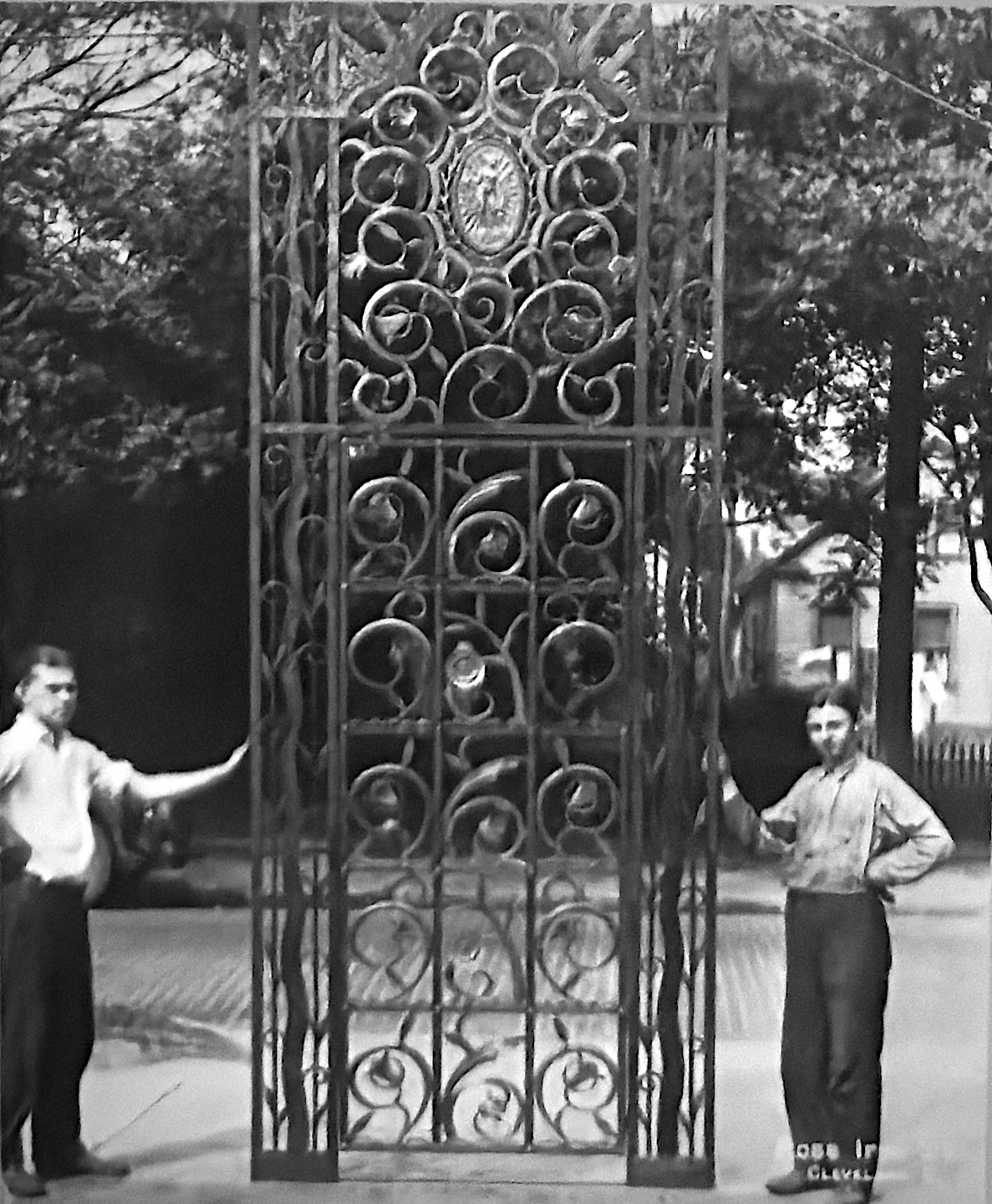
Grille for Halle Brothers Co. (1927)

Commissioned by the Halle Brothers Co. in 1927 this grille was for a dress room. It is now  in two pieces and missing its side panels.

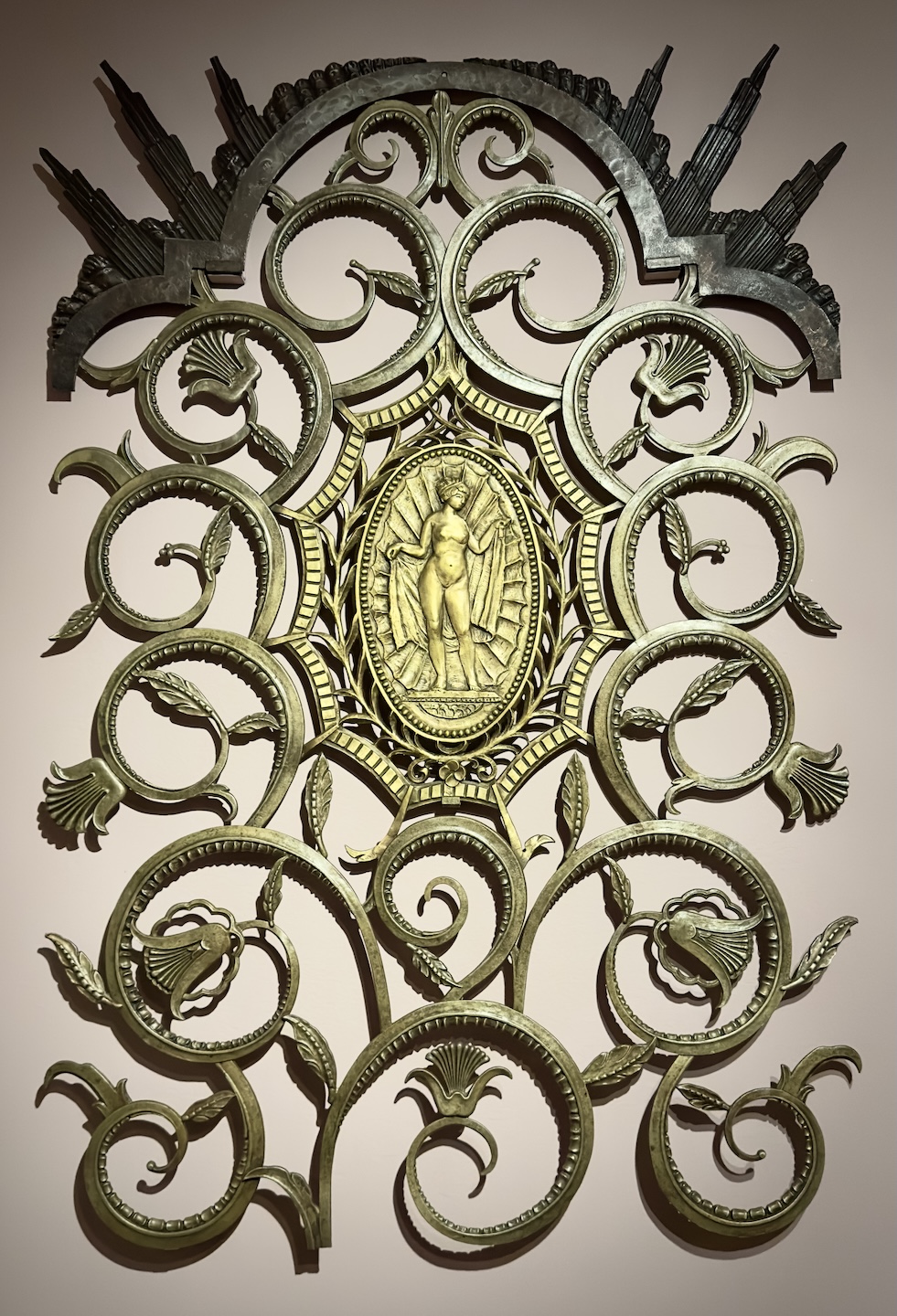
Halle Brothers Co. dress room grille (bottom half)

Bottom, center section of the Halle Brothers dress room grille.

Top center section of dress room grille for Halle Brothers.

Top center section of the Halle Brothers Co. grille

Vintage photograph showing the Halle Brothers Co. grille showing it in its complete state.

Vintage photograph showing the Halle Brothers Co. grille showing it in its complete state.

Designs by Paul Fehér

The designs of Paul Fehér for Rose Iron Works are some of the best examples of Art Deco metal work made in the United States. While he is best known for the Muse with Violin screen, his work encompassed many objects.

Designs for Door Handles and Lamps

Design for door handles and lamps, 1931.

Design for door handles and lamps, 1930.

Fehér door handle and light switch cover, by Paul Fehér, circa 1930.

Door handle of monel (nickel alloy), aluminum and light switch cover of steel, aluminum, circa 1930.

Floor Lamp

As sales declined due to the Great Depression, Fehér created a number of moderne pieces to display in the Rose Iron Works showroom, to attract potential customers. This lamp was one of the pieces.

Rose Iron Works collection floor lamp.

Floor lamp for display in the Rose Iron Works showroom. The glass tubes of the shades are modern replacements.

Detail of the shade showing the replacement glass tubes.

1931 photograph of the Rose Iron Works showroom, featuring the floor lamp and mirror and console table.

Fountain

Circa 1930, Fehér made a drawing of a fountain. The copper and aluminum fountain would not be executed until 1950.

Drawing for a fountain.

A Paul Fehér drawing for a fountain, circa 1930.

The 1950 fountain based on the 1930 design.

Copper and aluminum Rose Iron Works fountain, 1950.

The Muse Screens

But the real highlights of the exhibit were the two muse screens, Muse with Violin (1930) and Muse with Flower (2025).

Muse with Violin Screen

Chalk and crayon drawing of a Muse Screen.

Drawing in chalk and crayon of Muse Screen, with an unexecuted central figure.

The drawing used in the Rose Iron Works workshop for Muse with Violin screen.

Workshop drawing for Muse with Violin Screen, 1930.

Muse with Violin Screen.

A Paul Fehér masterwork, Muse with Violin, 1930, for the Rose Iron Works.

Muse with Flower

In 2022, third-generation Rose Iron Works owner, Bob Rose embarked on a project to create two new Muse screens. One of the new screens featured the unexecuted Paul Fehér figure from 1930. Muse with Flower Screen’s central figure was inspired by a picture of Rose’s wife smelling a flower. Using a combination of old techniques, such as original tools and molds and 3-D printing, the new screens continue Rose Iron Works Art Deco craftsmanship that began nearly 100 years ago.

The 2025 Muse with Flower Screen’s central figure for Rose Iron Works.

Muse with Flower Screen (2025). Designed by Bob Rose for Rose Iron Works.

Even though it was a small exhibition, it was well worth the drive from Rochester and back.

Anthony & Chris (The Freakin’ Tiquen Guys)


35 Years of Collecting Art Deco

May, 2017 marks the 35th year since I actively started collecting Art Deco items. Normally, I wouldn’t write a biographical post, but this is a something of a milestone. Looking back it seems I have always been collecting something and always drawn to things of the past. As a little boy I had Matchbox cars (what boy in the 1960’s didn’t).

Some Matchbox cars that I had in the 1960’s


But because I liked old cars better my parents started to get my the Matchbox Models of Yesteryear. Below are some of my favorites.


But the one I like the best was this one –

Packard, 1930

1930 Packard Victoria


At the time it was the only Model of Yesteryear of a car from the 1930’s. So, as you can tell by reading this, by six years old my interest in the time period between the World Wars had started.


Coins


As the 1970’s started, so did my coin collecting. I never had a spectacular collection, but it did help earn me my sole Boy Scout merit badge. One of the requirements for the merit badge is to compile a set of coins from the year of your birth. This is normally a pretty easy task. In 1963 the mint still produced silver coins, by 1975 they were long out of circulation. Finding these coins proved a bit of a challenge for an 11 year-old.


I stopped collecting coins soon after I earned my merit badge. But before I started on my next big obsession, a book came into my life that would consciously and unconsciously influence my collecting interests to this day. I had already started collecting 1939 New York World’s Fair memorabilia by the mid-1970’s. My interest in the fair came from all the stories my family told about attending it. And with my general interest in the 1930’s I received as a gift the book Collecting Nostalgia by John Mebane (1972, Popular Library).


Collecting Nostalgia, 1972.

The paperback edition of Collecting Nostalgia by John Mebane, 1972. Image from Amazon.com

Coca-Cola

This book had chapters on furniture, lamps, Mickey Mouse, World’s Fair & Buck Rogers collectibles. In 1975 this was the book that every 11 year-old boy dreamed about . . . not! But I liked it and it had a chapter on Coca-Cola. And it sparked my six year collecting quest of Coke memorabilia. I started off small, I picked up a 1944 Coca-Cola bottle at the Englishtown Auction (a very large flea market in Englishtown, NJ) for 25 cents.


My first Coca-Cola collectible.

The bottle that started it all. This variation of the famous 6 ounce Coca-Cola bottle was in production from 1938 – 1951. 1944 is the molding date stamped on this bottle.


It wasn’t long after buying that first bottle that the collection started to build. Soon I was buying anything I could afford that had Coca-Cola on it. Cans and bottles from different countries, paper goods, pencils, pocket knives, cardboard cut outs, well you get the idea. And my family often bought items for me that were out of my 11 – 16 year old price range, such as early straight sided bottles, trays and a really nice 1930’s ice cooler, the type that would be in front of a store or gas station.


Westinghouse Junior Ice Chest

Westinghouse, Junior Coca-Cola ice chest. Circa late 1930’s. This is like the model I had but in much nicer condition. I sold mine over 30 years ago. I still miss it. Image from Pinterest.

By 1979 my bedroom looked like a shrine for Coca-Cola. Beside the cooler taking up a corner of the room there were shelves with bottles, cans and glasses. Covering the walls were serving trays, signs and a large, illuminated clock, that made sleeping difficult, until the florescent light burned out.

Things go better with Coke clock.

1964 “Things go better with Coke” illuminated clock. Image from Pinterest.


While I have sold most of my Coca-Cola memorabilia, I have held onto the serving trays, they always go up in value. And if I come across any trays or early straight sided bottles at a good price, I can’t resist and I buy them. Old collecting habits die hard.

As the 1970’s turned into the 1980’s and my Coca-Cola collecting started to slow, my mother grew tired of seeing my Coke “museum”. Plus my bedroom needed a decoration update. It was 1973 when my parents decided on a decor for my bedroom. With the United States Bi-centennial only three years away everything went red, white and blue and colonial drums and eagles and my bedroom was no exception.

1982 from Coca-Cola to Art Deco

Not too far from where I lived I would go to Trash or Treasure, an antique store loaded with stuff and not neatly displayed. One needed to hunt around to find the treasure, but it was there, hiding. And one day in May of 1982, my mom noticed a pair of half circle, blue mirror end tables. Many years later I noticed December 21, 1939 stamped on the bottom. Blue glass tables would be popular for all of the 1940’s. They are considered Deco, even though that era came to an end by 1941. This would be the start of my Art Deco collection. $75.00 ($190.00 in 2017 money) was the price for the tables. They were in pretty good shape, but not perfect. But my mom saw this as a way out of the Coca-Cola museum and the now very dated Bi-centennial decor. She suggested I could turn the room into a little living room where I could entertain friends and watch old movies. The idea appealed to me, so we purchased the tables and in came the Deco and out went the Coke.

The half round end table that started the collection in 1982.

One of the two half round end tables that started the collection. In August of 1982 is when I bought the reproduction airplane lamp. Photo from 2017 in my present TV room.


The airplane lamp is a late 1970’s reproduction that used the original mold. I became familiar with that lamp, thanks to the Collecting Nostalgia book. Another early Deco purchase was a late 1930’s lucite table lamp with original shade. The shade had condition issues so I had the frame recovered with a similar fabric in the late 1980’s.


My late 1930's lucite lamp.

This is another early Art Deco purchase that has always been in use since I bought it in 1982 at the long gone Route 1 Flea Market in New Brunswick, NJ. I had the frame of the original shade recovered in the late 1980’s because of the tears. Photo taken in 2017.

The original 1982 room


The above photos taken with Kodak 110 Pocket Instamatic do not justice to the actual color of the room. The walls were a dove gray, with a wall paper border of light gray and white in a a pseudo 1980’s Deco pattern and the window blinds in a very pale gray. I had yet to learn how colorful the Art Deco period was.


As a celebration of my 35th anniversary of collecting Art Deco, my friends and I went to the Cooper Hewitt Museum in Manhattan for their exhibition – The Jazz Age American Style in the 1920’s.

The Jazz Age at the Cooper Hewitt.

The Cooper Hewitt’s exhibition The Jazz Age. It runs through August 20, 2017.


This exhibition is wonderful and has on exhibition items I’ve only seen in books or on line. If you happen to be in New York City and love Art Deco don’t miss this show.


Me at the Cooper Hewitt.

2017, me at 53 enjoying The Jazz Age exhibition at the Cooper Hewitt Museum. I had to have my picture taken next to my favorite Art Deco glassware, Ruba Rombic.


Anthony (One half of the Freakin’, Tiquen Guys).