
Quick, name a famous London detective and their address. Most would respond Sherlock Holmes at 221B Baker Street. While 221B Baker Street is an actual address, there is another famous detective who lives in Whitehaven Mansions which is – in a way – a fictitious address and building.
On our recent trip to London, Anthony surprised me by bringing me to Charterhouse Square. There, dominating the park, stood Florin Court. Those who watch PBS probably know the Agatha Christie Mysteries (my favorite author) and will recognize Florin Court as “Whitehaven Mansions” home to that famous Belgian detective, Hercules Poirot.
-

- David Suchet as Hercules Poirot – note his Susie Cooper dishware(via veniceclayartist. com)

BRIEF HISTORY of CHARTERHOUSE SQUARE
-

- Charterhouse Square circa 1560

The area known as Charterhouse Square started (presumably) as a burial ground for victims of the Black Death (1347-1351). In 1560, the land belonged to the Carthusian priory and acted as a division between private residences and trade businesses. At the priory’s dissolution, the grounds became open park land.
-
- Charterhouse Square circa 1676

By 1690, private residences with expansive gardens backing, and in some cases connecting, to the next street dominated the east side of the square. Four houses owned by Lord Grey occupied this area until 1694. A brewer, Peter Ward, acquired and demolished the structures redeveloping the land to build six houses.
-

- Charterhouse Square circa 1730

Time marches on and during sewer construction in 1834, human remains found in the park were removed A newly constructed rail system on the south side made the land too shallow for practical building on the square.
Retail spaces and warehouses replaced the surviving buildings to the north and west with private homes converted to staff housing for local wholesale clothing firms. By 1894, the area started to fall into decline with the park used for illicit assignations and vandalism becoming common.
In 1902, the 107 room Charterhouse Hotel opened on the northwest corner. It is the first purpose-built property on the square primarily for business clients and to supplement the need for housing. Print shops dominated the other buildings, alongside retail/wholesale spaces. Sold and re-purposed over the years, it is currently a hotel called Malmaison London.
As this middle-class area degraded, most of the private homes vanished. The square continued to decline with the remaining residences on the east side demolished in 1935. This made way for a flourishing revitalization in 1937. The new Charterhouse Hotel was built in the moderne style by the architects Guy Morgan & Partners for Charterhouse Ltd. (by 1937 Charter Estates). The builders were J. Gerrard & Sons Ltd. with interior decoration by Mrs. V. M. Thomas. The cost? About £74,000 (about $6,963,005.33 in 2018.) This at a time when the average worker earned £201.60 per year!
-

- Florin Court – inspiration for Whitehaven Mansions

The unusual façade of the building provided a view of the gardens below to the greatest number of rooms. The London County Council granted a special variance for the recessed center of the façade without the usual set-back. The only compromise to the design is that the two projecting wings have the uppermost floors set back allowing the top flats to have small roof gardens.
-

- Entrance of Charterhouse Hotel – now Florin Court. Note the cloud motif on the railings

The building consists of a steel-frame, clad in mottled pale yellow and brown brick made by Williamson Cliff Ltd. of Great Casterton, near Stamford. Special bricks over the entrance showcased the cantilevered canopy, covered in copper and sheet steel. The lobby originally boasted a marble floor inset with the Charterhouse coat of arms.
-

- Florin Court floor plans (photo via the internet)

Consisting of what are essentially 126 studio apartments, the architects hoped businessmen found the flats a convenient piedsà-terre (French for “foot on the ground”). Needing to be at the markets early in the morning, this avoided a lengthy morning commute from their primary residence. As seen above, only one flat per floor had two bedrooms and a sitting-room. The ground floor originally had a flat and office for the head porter. The basement consisted of a public restaurant, bar and club-room. Beneath was a garage with parking for twenty cars with squash courts located behind in a separate building.
Samples of real floor plans via stirlingackroyd. com (copyright photoplan)
-

- Studio 1 (via stirlingackroyd. com (copyright photoplan)

-

- Studio 2 (via stirlingackroyd. com (copyright photoplan)

-

- Studio 3 (via stirlingackroyd. com (copyright photoplan)

-

- Studio 4 (via stirlingackroyd. com (copyright photoplan)

-
- Studio 5 (via stirlingackroyd. com (copyright photoplan)

By the start of World War II, the few remaining print shops on the square could barely meet their financial obligations and one clergyman remained as a reminder of better, gentrified times. Post war Charterhouse Hotel struggled on, diversifying its clientele and by the 1950’s housed several small business offices.
In 1988, architects Hildebrand & Glicker and interior designer Andrew Dandridge renovated and restored the east side of the block at a cost of about £2 million. Renamed Florin Court, the building became fully residential boasting newly restored roof-top gardens, a gym, jacuzzi and a basement swimming-pool.
-

- Pool for residents of Florin Court (via frankharris.co.uk)

The first series of Poirot started shooting in 1988 with the newly renovated Florin Court selected to represent the façade and some interior shots of the fictional “Whitehaven Mansions”.
(Information from British-history.ac.uk)
REALITY VS. FANTASY
So, what more can I say? Consequently, fantasy is so much more than reality. Hercules Poirot’s beautiful flat would occupy the square footage of at least 3 actual units. Also, it would encroach on the structure next door due to the unusual slope of the northern wall of the real building.
-

- Poirot Apartment Plan Season 1-5 (via investigatingpoirot.blogspot.com)

-

- Poirot Apartment Plan Season 6 (via investigatingpoirot.blogspot.com)

Before I compare the fantasy vs. realty, lets look as some of the beautiful details thoughtfully and, in most cases, restored to their original beauty.
-

- Facade showing the sweeping “wing” and canopy (via british.history.ac.uk)

-

- The original lobby with the Charterhouse Coat of Arms. The 1988 restoration covered it with carpet (via british.history.ac.uk)

-
- Cloud handrails – motif carried in from the exterior (via thelondonphile. com)

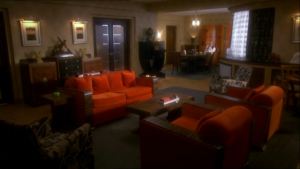
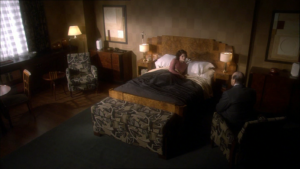
The comparisons below show the fantasy versus the reality.
-

- The Fantasy Living Room – (via investigatingpoirot.blogspot.com)
-

- The reality – lovely but not expansive (via stirlingackroyd.com)

-
- Sweet dreams (via investigatingpoirot blogspot com)
-

- Servicable and comfortable (via StudioFlats.London)

-

- Room for two, a table and free-standing stove (via investigatingpoirot blogspot com)

-
- Hope it’s not your turn for Thanksgiving dinner (via the internet)

-

- Nice and roomy (via investigatingpoirot blogspot com)

-
- Pretty and efficient (via the internet)


